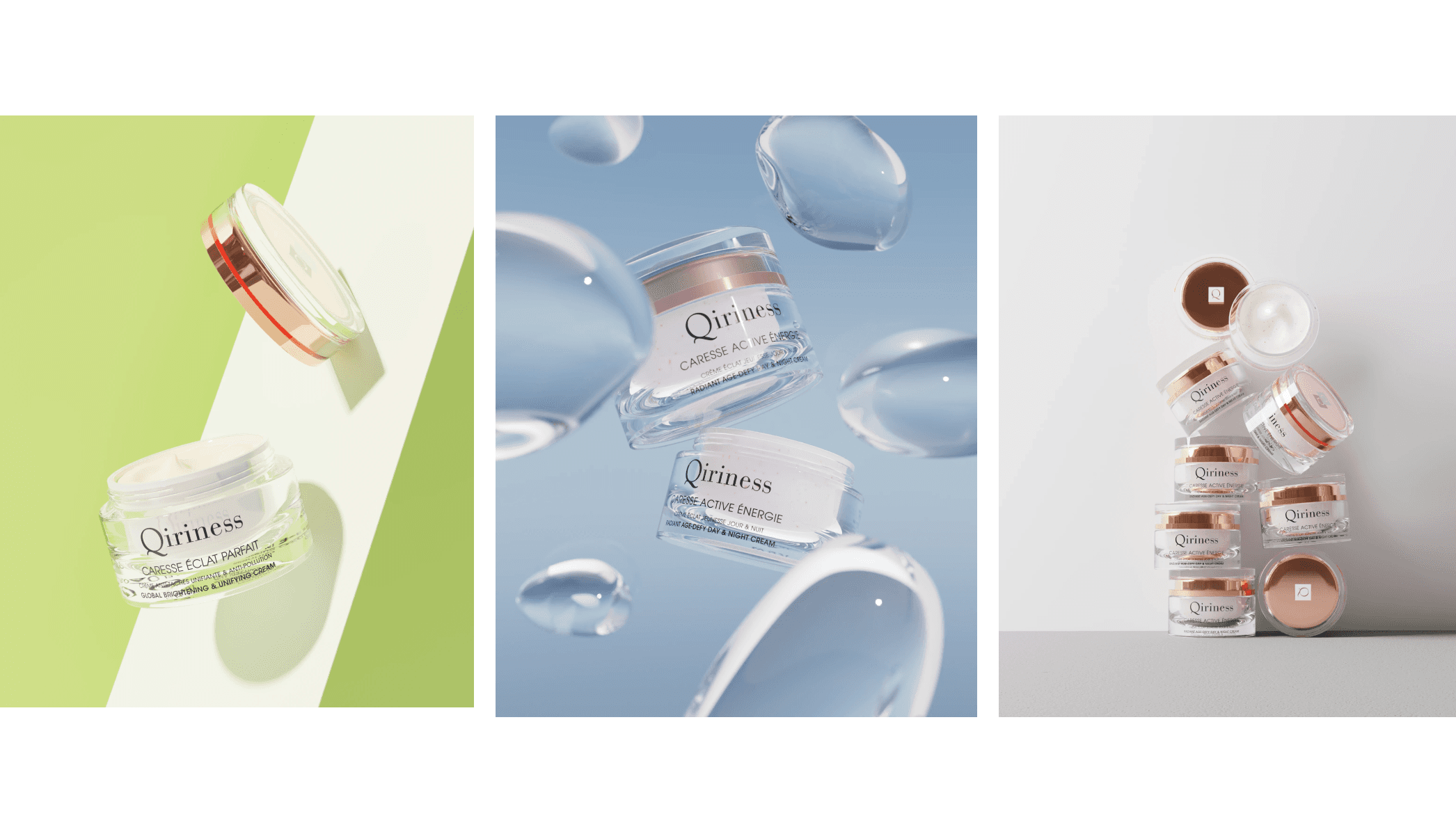
The Real Cost of Product Visuals: Photography, 3D, and AI Unpacked

Written by
Rachel Horvelin
12 dic 2025
Table of contents

The Real Cost of Product Visuals: Photography, 3D, and AI Unpacked
How top brands are rethinking visual production across channels and why legacy workflows are holding teams back.
In today’s world of multi-channel, multi-market, always-on marketing, visuals aren’t a one-time asset nor a nice-to-have. They’re infrastructure.
Every campaign, every variant, every channel - from PDPs, retail kits, packaging CRM, social media - depends on visuals that are not just beautiful, but brand-accurate, consistent, and built to scale.
Yet most brands still rely on outdated workflows that weren’t designed for the pace or complexity of today’s content needs. And they’re paying the price — in time, budget, inconsistency, and missed opportunity.
Let’s unpack the three main approaches - Photography, 3D, and AI - and what they actually deliver when it comes to real-world brand needs.
1. Photography: Familiar But Built for Another Era
Photography has long been the default. It’s trusted. It’s known. But in most cases, it’s no longer built for how brands operate today.
What seems simple - “just a shoot” - often turns into a complex, rigid, expensive operation:
Products must be shipped (sometimes internationally)
Studios, talent, lighting, and props must be booked
Legal, brand, and market teams must review, revise, and approve
Any updates mean reshoots, retouching, and delay
Every new claim, SKU, or region requires starting over
It works for hero campaigns or flagship moments. But the moment you need scale, speed, or systemization, photography collapses under its own weight.
You don’t just pay with budget. You pay with time, resources, and bottlenecks - every time something changes.
2. 3D Is the Backbone of Scalable Visual Production… If It’s Built Right
3D isn’t just a visual alternative to photography - it’s a foundational shift in how content gets produced. But for it to work at scale, quality is non-negotiable.
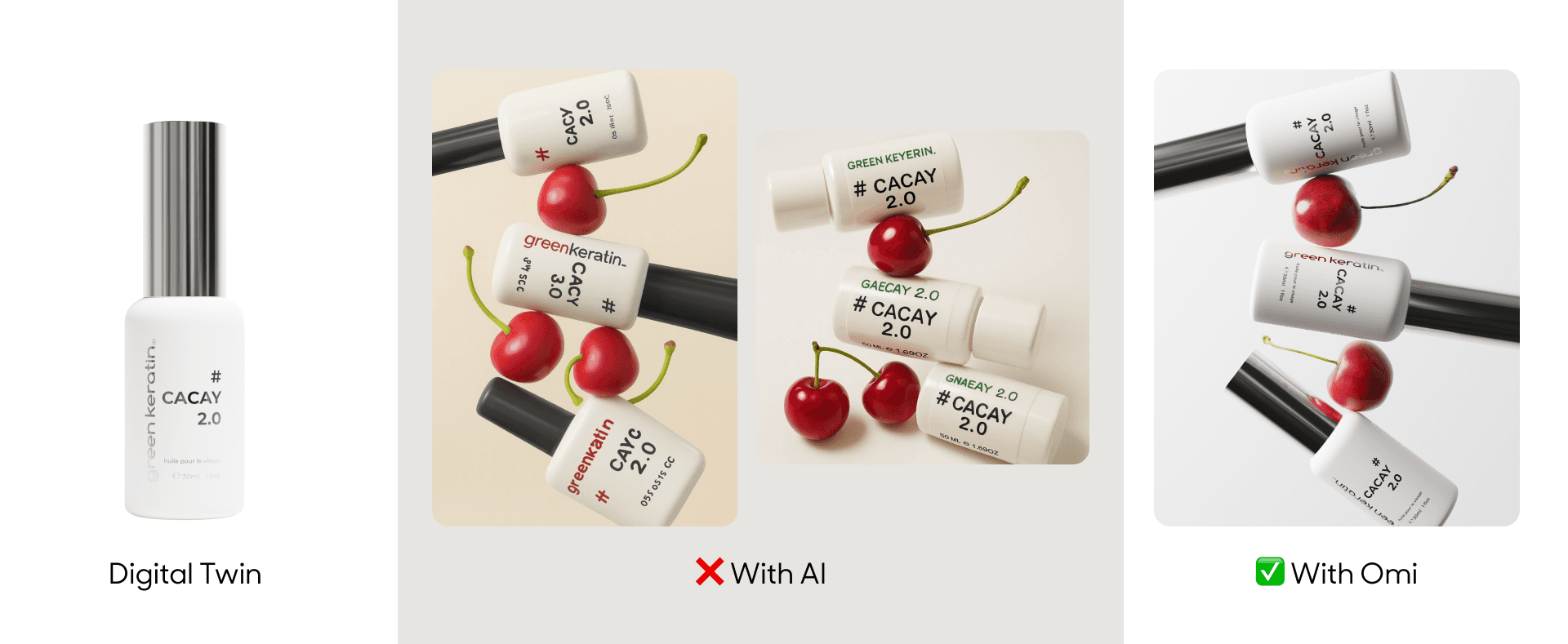
A true-to-life 3D model - your Digital Twin - becomes the visual source of truth across every touchpoint. Not a generic render, but a precise, brand-locked replica built from your real packaging specs: label files, finishes, dimensions, materials.
From that single source, teams can:
Generate pixel-perfect packshots from any angle (front, tilt, back-of-pack, top-down)
Create motion-ready assets: cap spins, droplet loops, gloss sweeps — all rendered from the same file
Localize content in seconds: update languages, compliance, or regional claims without manual redesign
Deliver consistency across formats: PDP, CRM, Amazon, print retail, paid social, internal toolkits
Update without restarting: change a label, finish, or shade, and every asset regenerates instantly
But this only works if the Digital Twin is built right. Low-quality 3D is a liability: wrong proportions, incorrect textures, inconsistent lighting. It creates more doubt than trust.
The power of 3D isn’t just the model itself. It’s the system it enables. A single, centralized foundation for modular content creation across SKUs, markets, and campaigns without ever going back to the studio.
This is what separates advanced visual teams from the rest: not just creating visuals faster but building a system that never breaks under complexity.

3. Gen AI: Fast, Flashy, But Inaccurate
Generative AI tools can produce visuals in seconds. For concepting, moodboards or early-stage creative ideation, they’re genuinely useful.
But when it comes to production-ready brand assets, especially for regulated, multi-market products? They fall apart. Here’s what actually goes wrong:
Packaging is inaccurate: logos are warped, labels float off center, containers don’t match the actual product
SKUs are invented: AI generates variants that don’t exist - the wrong cap, wrong shade, wrong pack
Claims and legal copy are missing or incorrect: “SPF 50+” might disappear or appear on the wrong product
Materials are distorted: textures like matte, glass, or foil look artificial or inconsistent across scenes
Scale is off: A 15ml bottle looks the same as a 100ml tube - no visual reference, no dimensional logic
Brand codes get broken: typography, color palette, even iconography is reinterpreted - often with a “stock image” look
Why does this happen? Because generative AI wasn’t trained to replicate with precision. It was trained to improvise. It predicts pixels, not packaging regulations.
For brands working across multiple SKUs, claims, and compliance zones, this is more than a visual glitch - it’s a liability:
Regulatory non-compliance
Customer confusion and returns
Brand dilution
Legal exposure in sensitive markets
Speed is meaningless if the visual can’t be published. That’s why creative teams experimenting with AI for final assets hit the same wall: it’s compelling but unreliable. Impressive but unusable.
Until AI can be grounded in structured, brand-controlled assets, it can’t own the visual pipeline. It can augment, but it can’t replace the production system. Not yet.
Why This Matters: Visual Content Is the Infrastructure of Modern Marketing
This isn’t a debate about static vs. motion. Or photography vs. 3D. It’s about whether your visual production model is built for the speed, scale, and complexity of modern brand operations.
Today’s teams don’t manage “a few” SKUs and “some” assets. They manage:
Multiple product variants - across shades, formats, and packs
Many markets - each with its own language, claims, and compliance rules
Weekly CRM and paid campaigns - personalized per product, region, and segment
PDPs, toolkits, and eRetail listings - all with strict formatting standards
Launches, relaunches, reformulations - each triggering dozens of new visuals
Pressure for “premium” output - with no extra time or headcount
This is the real visual economy inside top brands. And it doesn’t run on ad hoc workflows. It runs on infrastructure.
If your visuals depend on reshoots, manual retouching or recreating everything from scratch when claims or packs change, you don’t have infrastructure - you have overhead.
Here’s what’s really at stake:
If your visuals are late, your launch slips.
If they’re inconsistent, your brand perception drops.
If they can’t be localized instantly, you lose relevance and trust.
If every change means new production, your team burns out.
This is why top-performing brands are rethinking their entire visual stack - not just to save money, but to unlock speed, control, and global scale without creative compromise.
The Future of Visual Production
It’s not a question of choosing between photography, 3D or AI. The real unlock comes from combining the precision of 3D with the speed and flexibility of AI.
3D: Precision, Consistency, Reuse
Build a Digital Twin (photorealist 3D replica of your product) once then reuse it across all your channels, and markets. Every asset is consistent, on-brand, and fully controlled.
AI: Speed, Scale, Adaptation
AI brings that Digital Twin to life. It generates dynamic environments, localized templates, lighting setups, and short video loops — all in seconds, not weeks.
This is where content becomes infrastructure:
Turn a single Digital Twin into hundreds of assets instantly
Animate textures, reflections, and movement with zero post-production
Adapt to local languages, claims, and compliance needs
Make updates across your catalog in minutes - no reshoots, no delays
Packaging development scales without a product sample
This isn’t about replacing creativity. It’s about removing production bottlenecks - so your creative teams can focus on strategy, storytelling, and execution at scale.
Photography | 3D | AI | Omi | |
Cost Efficiency | High & variable costs (studio, team, logistics) | Depends on solution | Depends on solution | 10–20× cheaper than photography, fixed and predictable budget |
Speed | Weeks from booking to final delivery | Depends if done right | Fast but inconsistent | Studio-quality visuals in 2 minutes |
Consistency | Hard to replicate across shoots and markets | Depends if done right | Random, unpredictable | Same lighting, angles & brand look across visuals |
Flexibility | Limited by physical setups & inventory | Depends if done right | Limited control | Infinite backgrounds, props & lighting setups |
Scalability | Each new visual requires a new shoot | Depends if done right | Requires constant prompt tuning | Reuse 3D models to create visuals at scale |
Logistics | Requires samples, locations & full production team | Depends on solution | No logistics but unpredictable | 100% virtual workflow, no shipping or setup |
Creative Control | Fixed formats, limited retouch flexibility | Depends if done right | Limited output control | Fully editable scenes & export ratios |
Accuracy | Real-world accurate | Depends if done right | Frequent shape, text & scale errors | Pixel-perfect product replication with Digital Twins |
Brand Consistency | Hard to ensure | Depends if done right | Unpredictable | Guaranteed brand compliance |
Copyright safety / Security Certifications | Depends on studio | Depends on solution | Legal risks, public cloud, no control | Closed-source generation, private/VPC hosting, ISO 27001, SSO |
Speed & scalability | Slow, non-reusable | Depends if done right | Needs constant prompt tuning | On-demand image generation from reusable 3D models |
Creative flexibility | Limited by physical constraints | Depends if done right | Limited control | Combine AI backgrounds with photorealistic products |
Collaboration | Requires teams & physical coordination | Depends on solution | No collaboration/versioning | Multi-user workspace with shared templates |
Format Control | Fixed formats | Depends on solution | No ratio/format control | Custom export ratios, 360°, videos & static images |
When Visual Production Stops Slowing You Down
Great products deserve great visuals across every channel, market, and format. But that only works when the system behind the visuals is built for speed, scale, and consistency.
With the right setup, your team gets:
Faster turnarounds - new visuals in minutes, not weeks
Consistent output - every SKU, angle, and market aligned
Built-in flexibility - for last-minute changes, claims, and localizations
Fewer bottlenecks ) no reshoots, no backlogs, no starting over
This isn’t about working more. It’s about working from the right foundation.
That’s what Omi delivers: One Digital Twin. Infinite outputs. Visuals that keep up so your brand never falls behind.
Want to try our Virtual Studio?
About the author